Linkkit Team
Building the future of link management and analytics.
Enterprise Link Management
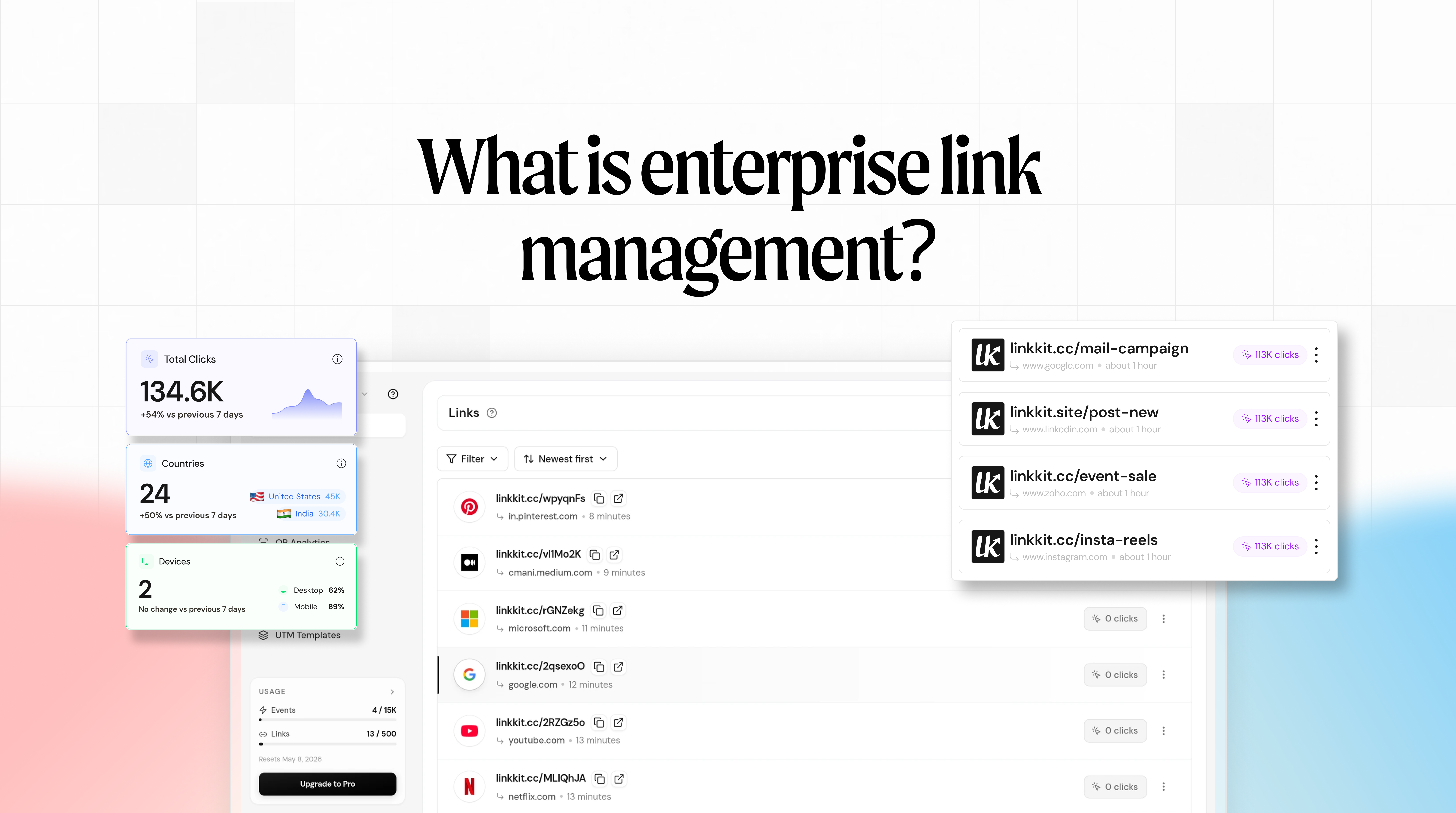
Enterprise link management is the process of creating, organising, tracking, and optimising links at scale across large organisations, multiple brands, or complex marketing operations. It goes well beyond shortening a URL or checking a click count. At the enterprise level, link management becomes a system — one that needs to handle hundreds or thousands of links across teams, campaigns, channels, and custom domains, all while keeping analytics centralised, branding consistent, and data reliable.
Linkkit is a short link and click analytics platform built for marketers, businesses, and growing teams who want clean branded links, real-time analytics, and QR codes without the complexity or cost of legacy enterprise tools.
What is Enterprise Link Management?
Enterprise link management refers to the tools, processes, and systems a business uses to control and measure every link it shares — at scale.
For a solo marketer, link management might mean creating a short link and checking clicks once a week. For an enterprise, it means something much bigger:
Hundreds of campaigns running simultaneously across email, social, paid ads, print, and events
Multiple team members creating and managing links across departments
Several branded domains representing different products, regions, or sub-brands
Links that need to be consistent, on-brand, and tracked with accurate data
Analytics that need to roll up into dashboards that executives and campaign managers can both use
At the enterprise level, a disorganised approach to link management creates real problems — broken links, inconsistent branding, lost click data, and no visibility into which channels, campaigns, or markets are actually driving results. A proper enterprise link management system solves all of that.
Why Enterprise Link Management Matters
Most enterprise marketing teams are sharing links every single day — in email campaigns, social media posts, paid ad copy, press releases, partner communications, QR codes on physical materials, and internal documents.
Without a structured approach, here is what typically happens:
Links become untrackable.
When different team members use different tools — or no tools at all — click data is fragmented or missing entirely. You cannot measure what you cannot see, and a link with no tracking is a campaign you cannot optimise.
Branding becomes inconsistent.
If half your team is using generic shorteners and the other half is using raw long URLs, every link your brand shares looks different. Branded link consistency is a trust signal — and inconsistency erodes it.
Campaigns cannot be audited.
When a campaign ends, your team should be able to look back at every link, every click, every channel, and understand what drove results. Without organised link management, that audit is impossible.
Links break and nobody notices.
Long raw URLs break when platforms truncate them, pages move, or parameters expire. With proper link management, redirects are controlled — you update the destination without touching the link itself.
Reporting is a manual nightmare.
Pulling click data from five different tools, cross-referencing with campaign spreadsheets, and building a report by hand every week is exactly the kind of work enterprise link management eliminates.
Key Features of Enterprise Link Management
Whether you are evaluating an enterprise-level platform or building out a link management system for your team, these are the features that matter at scale:
1. Centralised Link Dashboard
All links, all campaigns, all team members — visible in one place. A centralised dashboard lets managers see what has been created, what is performing, and what needs attention, without asking individual team members to pull data manually.
2. Multiple Branded Custom Domains
Enterprise organisations often manage several brands, product lines, or regional websites. A strong link management platform lets you connect multiple custom domains and assign different domains to different teams or campaigns. Every link stays on-brand regardless of which team created it.
3. Team Access and Permissions
Marketing teams, social teams, regional teams, agencies — enterprise link management needs role-based access. Who can create links? Who can edit destinations? Who can view analytics? These controls prevent mistakes, maintain brand standards, and ensure accountability.
4. Real-Time Click Analytics
At the enterprise level, real-time data is not a luxury — it is a requirement. When a campaign goes live, you need to know immediately whether it is performing. Waiting 24 hours for a data refresh is not an option when budget is being spent in real time.
Linkkit's click analytics tracks every click as it happens — location by country and city, device type, referrer source, and click patterns over time. Available for every link, from the moment it is created.
5. QR Code Generation and Tracking
Enterprise brands use QR codes at scale — on product packaging, retail displays, event materials, print ads, and direct mail. At the enterprise level, QR codes need to be dynamic (updateable without reprinting), tracked (every scan visible in analytics), and brand-consistent (no third-party watermarks or generic domains).
With Linkkit, every short link generates a dynamic, tracked QR code automatically. Download in SVG for print or PNG for digital. Every scan appears in your analytics dashboard alongside link clicks.
6. Editable Link Destinations
Enterprise campaigns change. Offers expire. Landing pages move. Products get renamed. A link management system that does not allow you to update destinations after creation will leave you with dead links across printed materials, email archives, and partner sites.
7. UTM Parameter Management
Enterprise marketers live in UTM parameters. Every campaign, every channel, every ad variation needs clean, consistent UTM tagging. A link management platform that builds UTMs into the link creation workflow ensures consistent attribution data flowing into your analytics stack.
8. Link Expiry and Scheduling
Enterprise campaigns often have hard end dates — a sale that closes at midnight, an event registration that ends on a specific day. Link expiry features automatically disable or redirect links after a set time, without requiring manual intervention.
9. Bulk Link Creation
Creating hundreds of links for a large campaign should not mean hundreds of manual steps. Enterprise link management platforms offer bulk creation — import a spreadsheet of URLs, generate all links simultaneously, and export the results.
10. API Access
For enterprise teams building link management into their own workflows, apps, or platforms, API access is essential. It allows developers to create, update, and query links programmatically — connecting the link management platform to your CRM, email platform, CMS, or any other tool in your stack.
Enterprise Link Management vs. Basic Link Shortening
Capability | Basic Link Shortener | Enterprise Link Management |
|---|---|---|
Short links | ✅ | ✅ |
Branded custom domain | Sometimes | Yes — multiple domains |
Real-time analytics | Rarely | ✅ |
Team access control | ✅ | |
Multiple domains | ✅ | |
Bulk link creation | ✅ | |
QR code tracking | Basic or none | Full — every scan |
Editable destinations | ✅ | |
API access | ✅ | |
Link expiry | ✅ | |
Centralised reporting | ✅ | |
Audit trail | ✅ |
The gap between a basic shortener and a proper link management system is significant. For enterprise teams running multiple campaigns across multiple channels simultaneously, the basic shortener approach creates invisible costs — in wasted time, lost data, inconsistent branding, and campaigns you cannot measure or optimise.
Common Enterprise Link Management Use Cases
Multi-Channel Campaign Tracking
A product launch runs across email, paid social, organic social, press outreach, and an event. Each channel gets its own tracked link — same destination, different slugs — so performance data is segmented by channel automatically.
Global and Regional Campaigns
An enterprise with offices in multiple countries runs localised campaigns. Each region gets links on their own regional branded domain, with analytics segmented by geography. The central marketing team sees a combined view. Regional managers see only their data.
Agency and Partner Link Management
Enterprises working with agencies or media partners need to provide trackable links for every placement. Enterprise link management gives agencies the links they need while keeping analytics and domain control in-house. No more relying on agency-reported numbers.
Print and Offline Campaign Measurement
QR codes on packaging, catalogues, in-store signage, and direct mail are tracked the same way as digital links. Every scan is attributed to the correct campaign and material type. For the first time, offline campaign ROI is measurable with the same rigour as digital.
Email Campaign Optimisation
Every link in every email campaign is tracked. Click-through rates by link position, device, country, and referrer. A/B testing different link placements is measurable. Over time, this data shapes how emails are structured and where the most important links are placed.
Event and Conference Materials
Event registration links, session materials, follow-up resources — all created as short branded links with QR codes. Every scan at the event venue is tracked and attributed to the specific piece of material that generated it.
What Enterprise Link Management Looks Like in Practice
Here is a real-world scenario that illustrates why enterprise link management matters.
A national retail brand is running a back-to-school campaign. The campaign runs across email newsletter (400,000 subscribers), paid social on Instagram and Facebook, in-store QR codes on shelf displays in 200 locations, a print insert in direct mail to 50,000 households, and an affiliate programme with 30 partner sites.
Without enterprise link management, this brand uses raw URLs in some places, a generic shortener in others, and has no QR tracking at all. At the end of the campaign, they know their total revenue. They have no idea which channel drove it.
With enterprise link management, each channel gets its own tracked link:
brand.link/bts-email — email campaign
brand.link/bts-instagram — Instagram
brand.link/bts-facebook — Facebook
brand.link/bts-store — in-store QR code
brand.link/bts-mail — direct mail insert
brand.link/bts-aff — affiliate programme
Every click and every scan flows into a single analytics dashboard. The marketing team sees which channel drove the most traffic, what time of day clicks peaked, which cities showed the most in-store engagement, and which affiliate partners sent the highest-converting traffic. That data shapes the next campaign. And the one after that.
How to Evaluate an Enterprise Link Management Platform
Can it handle multiple custom domains?
If you manage more than one brand, product, or region, you need multiple branded domains. A platform that limits you to one domain per account will cause problems at scale.
Does it offer real-time analytics?
Delayed data is not useful when campaigns are live and budget is being spent. Real-time analytics — available for every link, not just premium ones — is a baseline requirement.
How does it handle team access?
Can you give different team members different permission levels? Can you limit which domains or campaigns each user can access? Role-based access control protects your link infrastructure from mistakes.
Are QR codes dynamic and tracked?
Static QR codes with no analytics are close to useless for enterprise campaigns. You need dynamic codes that can be updated after printing, with full scan tracking in the same dashboard as your link analytics.
What does it cost at scale?
Some enterprise link management tools price per user per month, which scales poorly for large teams. Understand exactly what you will pay as your usage grows — and read the small print on overages.
Is there an API?
If you want to integrate link creation into your CRM, email platform, CMS, or custom workflows, you need API access. Ask to see the API documentation before committing.
How reliable is the redirect infrastructure?
A link that goes down for 30 minutes during a major campaign is a disaster. Ask about uptime guarantees and infrastructure redundancy.
Why Teams Use Linkkit for Link Management
Linkkit is built for marketing teams, growing businesses, and agencies that need real link management without the complexity or enterprise pricing of platforms designed for Fortune 500 companies.
Branded short links — connect your custom domain and every link reflects your brand
Real-time click analytics — full data on every link, from day one, on every plan
QR code generation — dynamic, tracked, no watermarks, downloadable as PNG or SVG
Editable link destinations — update any link destination without changing the URL
Clean, fast dashboard — manage all your links without a learning curve
Free plan available — no credit card required to get started
For enterprise teams that need higher link volumes, team collaboration, API access, and advanced features — paid plans scale with your usage without the aggressive per-user pricing of legacy platforms.
Conclusion
Enterprise link management is not about shortening URLs. It is about bringing order, consistency, visibility, and measurement to every link your organisation shares — across every channel, team, campaign, and market.
Done well, it turns links from a logistical necessity into a strategic data source. You stop guessing which channels are working and start knowing. You stop finding dead links after campaigns end. You stop losing attribution data in fragmented tools. You start making every link work harder.
Get started with Linkkit free today — no credit card required. Branded links, real-time analytics, and QR code tracking from your very first link.
Frequently Asked Questions
What is enterprise link management?
Enterprise link management is the process of creating, organising, tracking, and optimising links at scale across large organisations. It includes branded short links, centralised analytics, team access controls, multiple custom domains, QR code tracking, and editable link destinations — all managed from a single platform.
Why do enterprises need a link management platform?
Enterprises share hundreds or thousands of links across email, social media, print, events, and paid ads simultaneously. Without a centralised link management platform, click data is fragmented, branding is inconsistent, campaigns cannot be measured accurately, and broken links go undetected.
What is the difference between a URL shortener and an enterprise link management platform?
A basic URL shortener creates short links. An enterprise link management platform does much more — it provides branded domains, real-time analytics, team access controls, bulk link creation, QR code tracking, API access, and editable destinations. The difference is the difference between a tool and a system.
What features should enterprise link management include?
The core features are: branded custom domains, real-time click analytics, team access and permissions, QR code generation and tracking, editable link destinations, bulk link creation, API access, link expiry, and centralised reporting across all links and campaigns.
How does link management help with campaign attribution?
By creating separate tracked links for each channel — email, social, print, affiliates — enterprise link management platforms attribute every click to the correct source. This gives marketing teams accurate data on which channels drove traffic, clicks, and conversions for every campaign.
Can QR codes be managed in an enterprise link management platform?
Yes. Platforms like Linkkit generate dynamic QR codes for every short link automatically. Dynamic QR codes can be updated without reprinting, and every scan is tracked with full analytics — location, device, and time — alongside link click data.
Is Linkkit suitable for enterprise link management?
Linkkit is built for marketing teams, agencies, and growing businesses that need proper link management without enterprise pricing. It includes branded domains, real-time analytics, QR code tracking, and editable destinations on every plan. Paid plans support higher link volumes, team collaboration, and API access.
How does enterprise link management improve ROI measurement?
By tracking clicks per link, per channel, and per campaign — with full location, device, and referrer data — enterprise link management gives teams accurate attribution data. This shows which channels and campaigns generate the most clicks and conversions, allowing budget to be allocated to what actually works.