Linkkit Team
Building the future of link management and analytics.
Every product is a reflection of the decisions made by the people who built it. What to include. What to leave out. What to charge for. How to talk about it. What to do when something goes wrong.
Those decisions are shaped by values — whether or not anyone has ever written them down.
We've written ours down. Not as a PR exercise. But because we think you should know what we believe, since it shapes every part of how Linkkit is built and how it works.
Simple
Complexity is easy. Simplicity is hard.
It's easy to build a dashboard with 40 features and call it powerful. It's hard to build one that does exactly what you need and nothing more — where everything is in the right place, nothing requires explanation, and the most important action is always obvious.
Linkkit is built around simplicity as a design principle, not a limitation.
Every feature we add gets asked the same question: does this make Linkkit easier to use, or does it make it more complicated? If the answer is 'more complicated,' the feature either gets rethought or it doesn't ship.
This means Linkkit does fewer things than some of its competitors. That's intentional. A tool that does three things excellently is more valuable than a tool that does fifteen things adequately.
Clean
Clean is about honesty as much as aesthetics.
A clean product doesn't hide things. It doesn't bury important information behind tabs you'd never think to click. It doesn't make you wade through settings to find the one thing you're looking for. It doesn't use dark patterns to push you toward upgrades you don't need.
Clean also means clean pricing. We don't have hidden fees. We don't move features to paid tiers without warning. The free plan is what it says it is. The paid plans are priced based on what they actually cost us to provide and what they're genuinely worth to the people using them.
Clean means you always know what you're getting.
Human
This one matters most to us.
A human product remembers that the person using it has other things to do. It doesn't make you feel stupid when something doesn't work the way you expected. It writes error messages in plain language. It doesn't assume you know what a 'dynamic UTM parameter' is before you can create a link.
A human product is also honest about what it is and what it isn't. Linkkit is a short link and analytics tool. It's not a full marketing platform. It's not an enterprise CRM. We don't pretend otherwise, and we don't try to be everything to everyone.
And a human product cares about the people using it. When something breaks, we fix it and tell you what happened. When we make a decision that affects the product, we explain why. When someone reaches out, a real person responds.
How these values show up in Linkkit
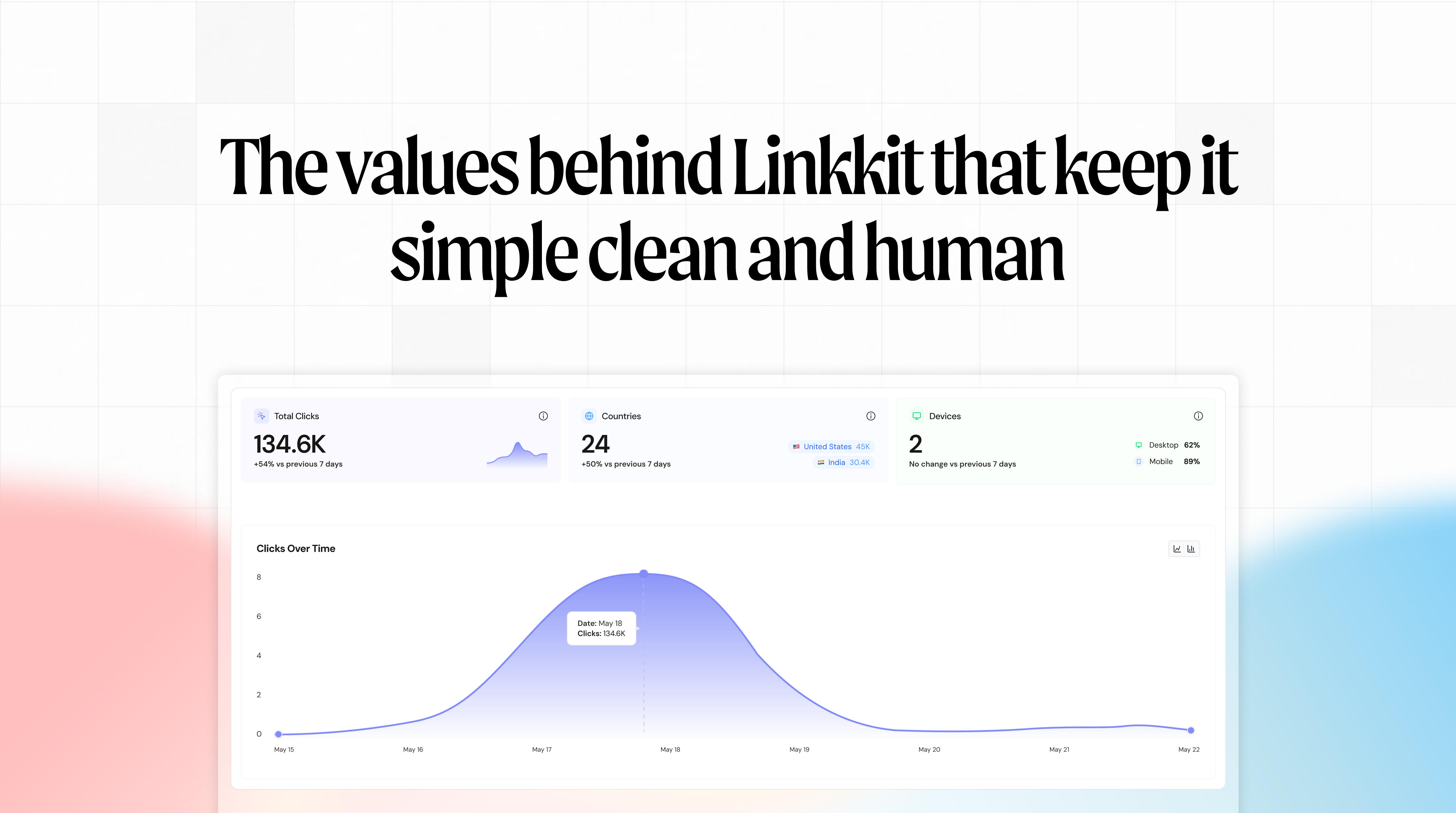
Simple is why the dashboard has one main view, not a maze of tabs.
Clean is why the free plan includes branded domains and full analytics — because gating basic features behind a paywall didn't feel honest.
Human is why we wrote this post, and why the blog exists — because we want you to understand what we're building and why, not just what the product does.
These values don't mean Linkkit is perfect. There are things we're still building. Features that aren't as smooth as they should be yet. Edges we're still rounding off.
But every time we ship something new, or change something existing, or decide what not to build — these three values are the filter.
Simple. Clean. Human.
That's what Linkkit is. That's what it's going to keep being.
Linkkit is FREE to start, TRACK your 500 clicks today.